 |
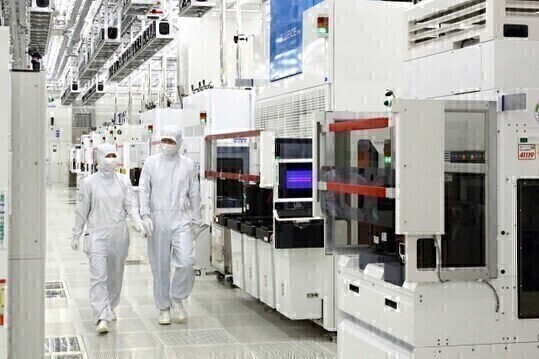
Samsung Semiconductor Manufacturing Facility. (Photo courtesy of Samsung Electronics) |
[Alpha Biz= Paul Lee] Although South Korea’s export performance and stock indices have reached all-time highs, eight out of ten manufacturing companies are taking a cautious approach this year, prioritizing stability in their business strategies.
According to a survey conducted by the Korea Chamber of Commerce and Industry (KCCI) from January 1–12, covering 2,208 manufacturing firms nationwide, 40.1% of respondents expect the overall Korean economy to slow compared with last year. Another 36.3% predicted it would remain similar, while 22.2% anticipated slight improvement. Only 1.4% forecast a significant improvement.
This cautious economic outlook is reflected in corporate management plans. When asked about their core management strategies for 2026, 79.4% of firms indicated they would either maintain current operations or downsize, a 14.4-percentage-point increase in conservative approaches compared with two years ago. Overall, the survey suggests manufacturers are emphasizing stability and risk management.
Sector-specific differences were evident. In the semiconductor industry, where a strong performance is expected, 47.0% of companies reported plans for expansion. Pharmaceutical, biotechnology, and cosmetics firms also showed above-average expansion plans, at 39.5% and 39.4%, respectively, far exceeding the overall average of 9.6%. In contrast, industries facing domestic slowdown or price competition, such as textiles and steel, were more likely to adopt downsizing strategies—20.0% of textile firms and 17.6% of steel firms.
More than half of the respondents (52.0%) cited economic and demand forecasts as the key factor influencing their 2026 management plans. Other major considerations included costs and profitability (25.9%), internal company conditions (7.6%), policy and regulatory changes (7.5%), and external trade risks (7.0%).
Regarding performance targets, most companies aim to match last year’s results, with 42.2% for domestic sales and 48.8% for exports setting performance goals at the previous year’s level.
When asked about the main risk factors that could constrain growth in 2026 (multiple responses allowed), external variables dominated. The most frequently cited risks were high exchange rates and increased volatility (47.3%), oil and raw material price fluctuations (36.6%), trade uncertainties from the U.S. (35.9%), and global economic slowdown (32.4%). Domestic factors, such as stricter corporate legislation (19.4%) and demographic challenges weakening domestic demand (12.5%), were mentioned by a smaller proportion of firms.
알파경제 Paul Lee 특파원(hoondork1977@alphabiz.co.kr)