
 |
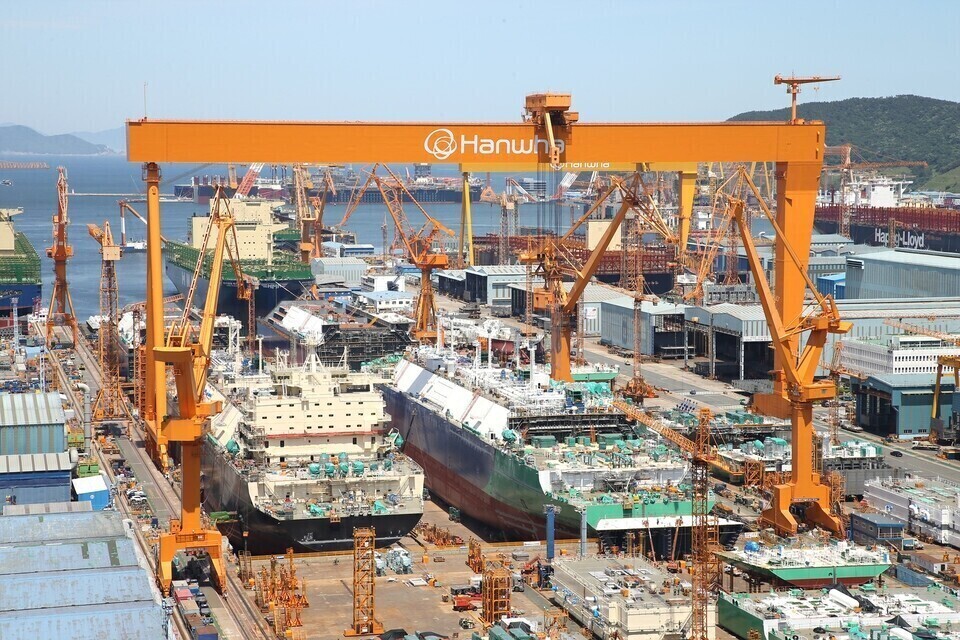
Hanwha Ocean Geoje Shipyard. (Photo courtesy of Hanwha Ocean) |
[Alpha Biz= Kim Jisun] South Korea’s three largest shipbuilders recorded combined operating profits nearing KRW 6 trillion last year, driven largely by strong global demand for high-value liquefied natural gas (LNG) carriers, industry data showed.
According to industry sources on February 4, HD Korea Shipbuilding & Offshore Engineering, Hanwha Ocean, and Samsung Heavy Industries posted a combined operating profit of KRW 5.8758 trillion for the year. This marks more than double the KRW 2.1747 trillion recorded in 2024, when the three companies returned to profitability together for the first time in 13 years.
Individually, Hanwha Ocean reported revenue of KRW 12.6884 trillion and operating profit of KRW 1.1091 trillion, up 17.7% and 366.2% year-on-year, respectively. The result marks the company’s return to the “KRW 1 trillion operating profit club” for the first time since 2018, when it operated as Daewoo Shipbuilding & Marine Engineering.
HD Korea Shipbuilding & Offshore Engineering posted operating profit of KRW 3.9045 trillion, up 172.3% from a year earlier, while Samsung Heavy Industries recorded KRW 862.2 billion, a 71.5% increase year-on-year.
Industry analysts attribute the strong performance largely to LNG carriers, which command significantly higher margins than conventional vessels. An LNG carrier typically sells for around USD 250 million (approximately KRW 360 billion), with construction margins estimated to be about twice those of other ship types, due to the advanced technology required to safely transport LNG at –163°C.
The three shipbuilders structured their order strategies around LNG carriers, benefiting from global energy market trends, including LNG export expansion projects under the Trump administration. At the same time, tightening environmental regulations by the International Maritime Organization have boosted demand for eco-friendly vessels.
A Hanwha Ocean official said, “The expansion of high-margin LNG carrier deliveries last year drove growth in our commercial shipbuilding division.”
Korea’s competitiveness has also strengthened in the global market. According to Clarksons Research, global ship orders declined 27% year-on-year in 2024, while South Korea’s total order volume increased by 8%, highlighting the effectiveness of a selective, value-focused order strategy.
Momentum has continued into this year. HD Korea Shipbuilding & Offshore Engineering has already secured orders for 12 vessels, including five LNG carriers, three LPG and ammonia carriers, two crude oil tankers, and two petrochemical carriers, totaling USD 1.93 billion (approximately KRW 2.8 trillion). Hanwha Ocean and Samsung Heavy Industries have each won orders for five vessels, including LNG carriers.
Combined, new orders secured by the three shipbuilders this year are approaching KRW 5 trillion. Samsung Heavy Industries has set its 2025 order target at USD 13.9 billion, up 76% from last year, while HD Korea Shipbuilding & Offshore Engineering raised its target by 28% to USD 23.3 billion.
Alphabiz Reporter Kim Jisun(stockmk2020@alphabiz.co.kr)