 |
Photo courtesy of Yonhap News |
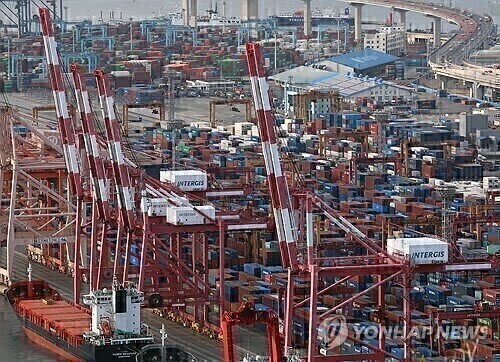
[Alpha Biz= Paul Lee] South Korea’s cumulative annual exports have exceeded USD 700 billion for the first time, underscoring the resilience of the country’s export-driven economy despite mounting global trade uncertainties, including rising protectionism and U.S. tariff pressures.
According to the Ministry of Trade, Industry and Energy (MOTIE) and the Korea Customs Service, cumulative exports reached USD 700 billion as of 1:03 p.m. on the 29th, based on preliminary figures. This marks the first time Korea has reached the milestone, seven years after surpassing USD 600 billion in 2018.
With this achievement, Korea has become the sixth country to surpass USD 700 billion in annual exports, moving up from seventh place at the USD 600 billion level and demonstrating one of the fastest export growth trajectories among major exporting nations.
The government emphasized that the milestone is particularly meaningful given the challenging global environment marked by U.S. tariff pressures and the expansion of protectionist policies. Despite weak domestic demand, exports have served as a key pillar supporting economic growth and job creation, while helping maintain economic stability through a trade surplus despite Korea’s heavy reliance on energy imports.
From January 1 to December 28, energy imports totaled USD 117.4 billion, while the trade surplus reached USD 73 billion.
Export performance weakened in the first half of the year amid domestic and external uncertainties, but rebounded strongly following the launch of the new administration, as market confidence recovered and uncertainties—such as U.S. tariff negotiations—were resolved. From June onward, monthly exports set record highs for six consecutive months, with September exports reaching an all-time monthly high of USD 65.9 billion.
By sector, semiconductors led export growth, followed by automobiles, shipbuilding, and bio-related industries. Semiconductor exports totaled USD 152.6 billion from January to November, up 19.8% year-on-year, already surpassing the previous annual record. Driven by growing demand for AI servers and rising prices, semiconductors accounted for nearly one-quarter of total exports.
Automobile exports reached USD 66 billion despite U.S. tariff pressures, supported by market diversification and the expansion of eco-friendly vehicle offerings. Shipbuilding exports exceeded USD 30 billion for the first time in eight years, fueled by strong demand for high-value vessels such as LNG carriers. The bio-health sector also maintained solid growth, supported by increased biosimilar exports and contract manufacturing.
Qualitatively, Korea’s export structure has continued to diversify. Consumer goods such as K-food and K-beauty, along with electrical equipment and other emerging sectors, have emerged as new growth drivers. Export destinations have also diversified, with reduced dependence on China and the United States and increased exports to ASEAN, the EU, and Latin America. Small and medium-sized enterprises (SMEs) also recorded all-time highs in both export value and number of exporting firms through September, further broadening the export base.
Foreign direct investment (FDI) also increased significantly alongside strong export performance. Although inflows were sluggish in the first half, renewed investor confidence following the launch of the new government, investment promotion efforts surrounding the APEC summit, and expanded policies for advanced industries such as AI and semiconductors pushed total pledged FDI above USD 35 billion this year.
In particular, greenfield investments—establishing new factories and business facilities—rose sharply, contributing to regional economic revitalization and job creation.
Looking ahead, the government said it will continue efforts to sustain export and investment momentum through manufacturing innovation, export market and product diversification, structural trade reforms, and expanded incentives for foreign investment outside the Seoul metropolitan area. The government aims to achieve exports exceeding USD 700 billion and foreign direct investment of more than USD 35 billion for a second consecutive year.
알파경제 Paul Lee 특파원(hoondork1977@alphabiz.co.kr)