 |
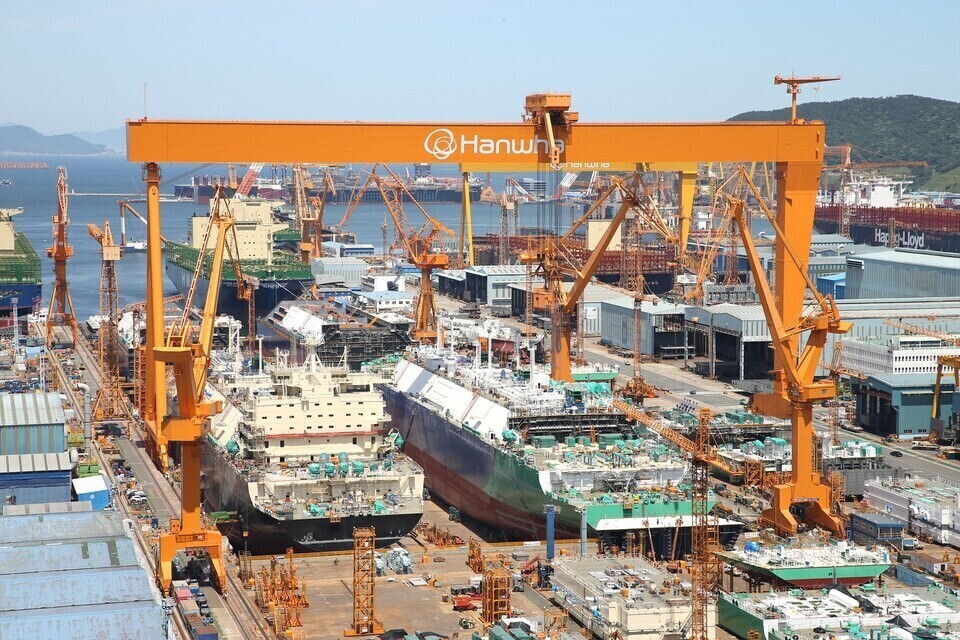
Hanwha Ocean’s Geoje shipyard in South Gyeongsang Province, South Korea (Photo courtesy of Hanwha Ocean) |
[Alpha Biz= Kim Jisun] South Korea’s state-run trade insurer and export credit bank suffered losses of $59 million (approximately KRW 85 billion) after releasing collateral to a U.S. offshore drilling company without sufficient due diligence, the country’s audit watchdog said on Wednesday.
According to the Board of Audit and Inspection, the losses stemmed from lax risk management by Korea Trade Insurance Corporation (K-SURE) and Export-Import Bank of Korea (KEXIM). While the audit report did not disclose the company’s name, the collateral is widely believed to be linked to Seadrill, which ordered drillships from Samsung Heavy Industries and Daewoo Shipbuilding & Marine Engineering (now Hanwha Ocean) in the 2010s.
The audit revealed that in 2013, a U.S. offshore drilling firm financed the purchase of three deepwater drillships by borrowing $340 million from KEXIM and another $340 million from commercial banks guaranteed by K-SURE. The lending syndicate required long-term charter contracts as a precondition for loan disbursement and took joint collateral over vessel ownership and charter hire revenues.
However, when one of the long-term charter contracts was delayed, the lenders approved the drawdown of $110 million based only on short-term charters and letters of intent. In the following year, the lenders further agreed to release part of the vessel collateral in exchange for early repayment, relying primarily on corporate guarantees without reassessing underlying risks.
As long-term charters ultimately failed to materialize and oil prices plunged, the borrower faced severe liquidity stress and entered court-led restructuring. As a result, K-SURE and KEXIM finalized losses totaling $59 million in 2023, the audit found.
The audit office pointed out that the downturn in the offshore drilling market and the sharp fall in global oil prices were foreseeable risks at the time, yet the lenders failed to adequately reassess collateral and credit exposure.
Separately, the Board criticized K-SURE’s overall risk management, noting that its average loss ratio on export credit guarantees over the past five years reached 579%, an “excessively high” level. The watchdog also found that K-SURE failed to properly share credit information with other policy lenders, leading it to assume guarantees previously rejected by other institutions and resulting in additional losses. Furthermore, inadequate checks on wage arrears allowed financially distressed companies to receive guarantees, triggering further guarantee defaults.

Alphabiz Reporter Kim Jisun(stockmk2020@alphabiz.co.kr)